The main event
The most reliable rhino viewing in Kenya
And the most sobering twenty minutes available to a visitor here.
Black rhino
Ol Pejeta holds the largest black rhino population in East Africa. They are browsers — they eat leaves and shoots rather than grass — so they favour thicker cover and take more finding than white rhino.
They are also solitary, short-tempered and prehistoric-looking. Seeing one properly is worth the patience.
Southern white rhino
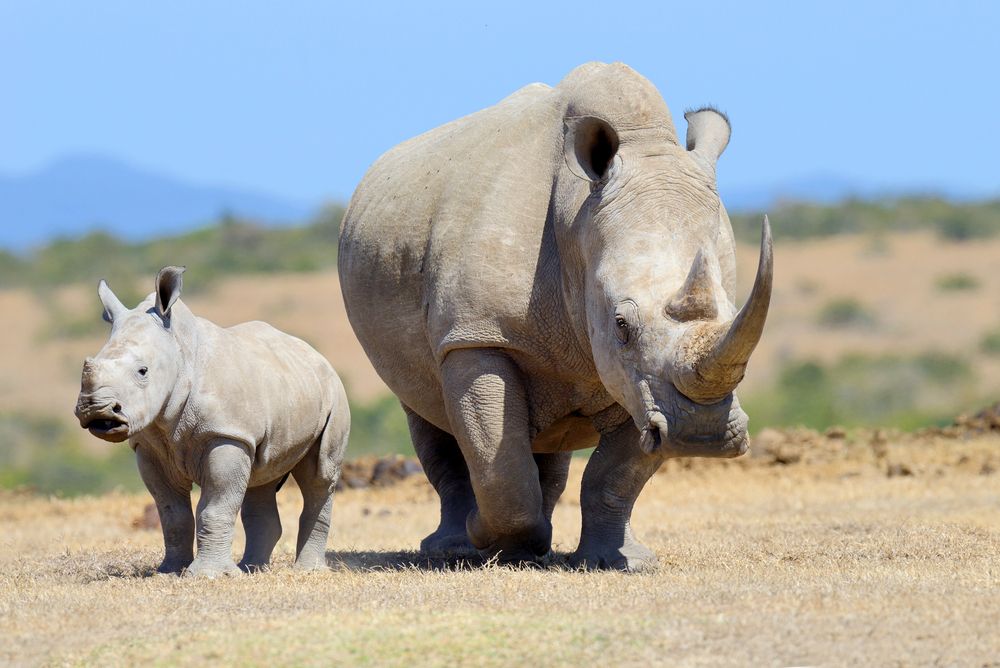
Grazers, so they are out on open grassland where you can see them, often in small groups. They are the reason a first-time visitor to Ol Pejeta almost always sees rhino on their first drive.
The square lip is the giveaway: built for cropping grass, where the black rhino has a hooked lip for grabbing branches.
The last two northern white rhinos
At the time of writing, the world’s last two northern white rhinos live at Ol Pejeta under permanent armed guard. Both are female. The subspecies is functionally extinct — there is no possibility of natural reproduction.
Work continues using stored genetic material and assisted reproductive techniques, in a collaboration between the conservancy and several research institutions. Whether it succeeds is genuinely uncertain.
What visiting them is like
Access is managed and limited, and the arrangements change — we will tell you what is currently possible rather than promising anything.
What we will say: standing in front of the last two members of a subspecies is not like other wildlife viewing. Children in particular tend to go very quiet, and the conversation on the drive back is different from the one after a lion.
Why rhino viewing works here
Because it is a conservancy rather than an open system. The population is intensively monitored — individual animals tracked continuously by rangers — and protected by dedicated anti-poaching teams and dog units.
That monitoring is also why a guide can find them. It is not luck; it is an operation, and you are funding it.
Rhino elsewhere in Kenya
- Lake Nakuru — fenced, both species, reliable. Good if you are driving the Rift Valley anyway.
- Laikipia conservancies — Lewa and Borana hold significant numbers, with rhino tracking on foot at some.
- Masai Mara — black rhino are present but genuinely scarce. Do not plan around seeing one.
- Meru and Tsavo West — fenced sanctuaries within the parks.
More from our Kenya guides
Specialist guides across our Kenya network
Each of these is a focused guide we publish. Same Kenya specialist behind every enquiry.
Ready to turn this into a real itinerary?
Send us your dates, who is travelling and roughly what you want to spend per person per night. Our Kenya specialist comes back within 24 hours with a plan built around them and a costed quote.